

Solicitors specialising in defending allegations of non-fatal strangulation and suffocation (London & Manchester)
Facing an allegation of non-fatal strangulation is a serious and worrying situation. Non-fatal strangulation is a relatively new criminal offence in England and Wales, introduced in 2022 to strengthen domestic abuse laws.
This page provides an overview of what this offence involves, the legal definitions and relevant legislation, potential sentences and recent case law developments and how Olliers Solicitors can assist individuals facing such allegations. Our aim is to inform and reassure you with clear information and supportive guidance.
New Law Introduced in 2022
The offence of non-fatal strangulation was created by Section 70 of the Domestic Abuse Act 2021 taking effect on 7 June 2022. It fills a gap in the law by specifically criminalising strangulation and suffocation that do not result in death.
No Visible Injury Required
The law does not require proof of serious physical injury for a conviction. Intentionally strangling someone (or otherwise impeding their breathing) is an offence in itself, even if
the victim has no obvious lasting injuries.
Up to 5 Years Imprisonment
Non-fatal strangulation is triable either in the Magistrates’ Court or Crown Court. The maximum sentence on indictment (Crown Court) is five years in prison. Even lesser instances often lead to immediate custody due to the offence’s serious nature.
Specialist Legal Support Available
Olliers Solicitors has specialist criminal defence lawyers experienced in domestic abuse allegations, including non-fatal strangulation cases. We offer supportive, proactive representation from the investigation stage through to court
proceedings.
The offence of non-fatal strangulation is a relatively new offence, which came in by virtue of The Domestic Abuse Act 2021. The Domestic Abuse Act 2021 introduced offences of non-fatal strangulation and nonfatal Suffocation as well as offences of racially and religiously aggravated non-fatal strangulation and suffocation. The offences came into force in June 2022 and are not retrospective which means you can’t be prosecuted for allegations which predate the law coming into force. The Domestic Abuse Act has changed the landscape for investigations and prosecutions in relation to domestic allegations. Frequently we are seeing individuals being arrested initially in relation to just one incident and then the investigation becoming far wider and broadening out and involving other types of domestic incidents. The law doesn’t provide a definition of non-fatal strangulation and the word should be given its ordinary meaning. The offence applies where the strangulation is non-fatal and doesn’t result in the death of the victim. Again for nonfatal Suffocation, the law doesn’t provide a definition of suffocation. The word should be given its ordinary meaning which is to deprive somebody of air so that it affects their ability to breathe. At Olliers we understand the complexity of domestic-related incidents, we understand that there are two sides to every story and the side presented to the police in the initial complaint may not be what has actually happened. Allegations May date back over extended periods, they may involve allegations of sexual abuse, financial control, emotional abuse and far more. Often domestic-related allegations run in parallel with other matters between the parties, for example, proceedings before the family court, proceedings in relation to divorce and financial aspects of the separation. We often tend to find that complaints are made or additional complaints are made to the police at specific time periods during the family proceedings to coincide with important dates in those proceedings. We appreciate that matters are rarely as straightforward as may be presented to the police and the prosecution. We’re often contacted by clients who may have been initially arrested and then released subject to pre-charge bail or released under investigation and have not yet been charged, this pre-charge stage of the case is absolutely crucial it’s the opportunity to be proactive, go on the front foot and engage proactively with the police and prosecution. We will always aim to make successful representations against charge and do all we can to minimize the chances of prosecution and the matter proceeding to court. We will look to engage with the police at the earliest stage of the investigation and adopt a process known as pre-charge engagement. We will seek to establish that there is not a realistic prospect of conviction, or it is not in the public interest to prosecute that being the test for prosecution. If you are facing an allegation of nonfatal strangulation or indeed any allegation of a domestic nature then please contact our specialist team at Olliers and we will be able to explain how our proactive approach can assist you in relation to your case.
Related Content
Related Articles
- What is Non-Fatal Strangulation?
- 119 Domestic Abuse Protection Orders (DAPOs) issued across Greater Manchester
- MAPPA and Controlling & Coercive Behaviour
- New guidelines for blackmail, kidnap and false imprisonment
- Defending false domestic allegations
- New sentencing guideline for strangulation and suffocation offences
- Domestic Abuse Protection Notices & Orders (DAPNs AND DAPOs)
- Controlling and Coercive Behaviour – the easy target?
- DARVO and domestic violence cases
- Case law sentencing update regarding non-fatal strangulation
- Sentencing update regarding intentional strangulation
- Love Bombing added to CPS guidance on Controlling and Coercive behaviour
- Controlling and Coercive Behaviour in an Intimate or Family Relationship – update introduced by s.68 of the Domestic Abuse Act 2021
- February 2023: Domestic Abuse raft of new measures
- The Domestic Abuse Act 2021
- New Laws on Non-Fatal Strangulation and Suffocation
What is Non-Fatal Strangulation?
Non-fatal strangulation refers to strangling or suffocating someone without killing them, typically as a form of violence or control. It has been recognised as a particularly dangerous form of assault often seen in domestic abuse situations. Studies showed that attackers who strangle their partners can pose an extreme risk – in fact, victims of prior strangulation are many times more likely to later be killed by their abuser.
Because strangulation often leaves little to no visible injury, perpetrators in the past could evade serious charges under existing laws like assault or actual bodily harm.
To address this gap, Parliament created a specific offence of “strangulation or suffocation” under the Domestic Abuse Act 2021. This new law makes it easier to prosecute and punish strangulation as a standalone offence, even when the victim’s injuries might appear minor. The offence applies to England and Wales and came into force on 7 June 2022
Under this law, any person who intentionally strangles another person, or does any other act that affects the victim’s ability to breathe (for example, suffocating them by covering the mouth/nose or compressing the chest) commits an offence – whether or not the victim suffers visible harm. The focus is on the dangerous act itself rather than the outcome.
It’s important to note that “non-fatal” simply means the victim was not killed – it does not mean the act isn’t serious. Non-fatal strangulation is treated as a very serious offence by police and courts because of its terrorizing nature and potential to cause unconsciousness, lasting injury (e.g. neurological damage), or psychological trauma. Victims often recount fearing they would die during such an attack, and this inherent trauma is one reason the law imposes tough penalties
Legal Definition – Non-Fatal Strangulation
The offence of non-fatal strangulation was introduced by Section 70 of the Domestic Abuse Act 2021, which added Section 75A to the Serious Crime Act 2015 specifically to cover strangulation and suffocation
In legal terms, the offence is titled “strangulation or suffocation”. There is also a related Section 75B covering extraterritorial jurisdiction (meaning British nationals or residents can be prosecuted in England and Wales for doing this abroad).
According to Section 75A of the Serious Crime Act 2015 (as inserted by the Domestic Abuse Act):
‘A person (“A”) commits an offence if A intentionally strangles another person (“B”), or A does any other act to B that – (i) affects B’s ability to breathe, and (ii) constitutes a battery of B.’
In plain English, this means it’s illegal to intentionally apply pressure to someone’s neck (strangling) or do anything that stops them from breathing (suffocating) when that act involves unlawful force. The term “battery” here just refers to the use of unlawful force or violence on someone (for example, covering someone’s nose and mouth to stop them breathing is unlawful force and thus a battery, as well as suffocation).
Notably, the law does not require any injury such as bruises or marks. There is no need to prove the victim was harmed physically (no requirement of actual bodily harm) as long as it’s proven that the offender intentionally strangled the victim or impeded their breathing. This was a deliberate element of the legislation, because previously strangulation often went unpunished if it didn’t cause visible injury. Under the new offence, the act itself is criminal due to the inherent risk and fear it causes.
The legislation itself doesn’t provide a detailed definition of “strangle” or “suffocate,” so these words are given their ordinary meaning. In practice, strangulation means applying pressure to the neck (with hands, a ligature, or any body part) to block airflow or blood flow. Suffocation can include a wider range of acts that block breathing, such as covering the mouth and nose, or placing an object over the face, as long as it’s done intentionally and involves force
Prosecutors are advised that strangulation doesn’t require proof of intent to kill or any specified level of force – any intentional compression of the neck is sufficient
Consent as a defence
In rare situations, a defendant might argue that the other person consented to the act (for instance, in a consensual sexual context sometimes referred to as “erotic asphyxiation”). The law does allow consent as a defence only in very limited circumstances.
If the strangulation or suffocation did not cause serious harm, and the accused genuinely believed the other person consented, this could potentially be a defence.
However, the defence is completely ruled out if the victim suffered “serious harm” (defined as serious injury like Actual Bodily Harm or worse) and the accused intended to cause serious harm or was reckless about causing serious harm
In short, you cannot consent to somebody seriously harming you. This reflects established legal principles (often referred to as the “rough sex” or R v Brown rules) that one cannot consent to serious injury. In most domestic abuse cases, consent is not relevant, but it could arise in, say, a consensual sexual scenario that accidentally went too far – even then, if significant injury was caused, consent would fail as a defence.
Sentencing Guidelines – Non-fatal strangulation
Non-fatal strangulation is classified as a “triable either way” offence. This means it can be dealt with in the Magistrates’ Court or the Crown Court, depending on the seriousness of the case. Less serious instances might stay in Magistrates’, whereas more serious cases (or where the facts merit a higher punishment) will go to Crown Court.
The maximum sentence for this offence is 5 years’ imprisonment on conviction in the Crown Court. This is set by law and reflects Parliament’s view of the gravity of the offence. If the case is kept in the Magistrates’ Court (for example, if the offence is relatively minor and suitable to be handled summarily), the maximum the magistrates can ordinarily impose is 12 months’ imprisonment (note: 6 months per offence, typically up to 12 months total for either-way offences since the Sentencing Act 2020). In either court, the offence can also attract a fine or a community-based sentence in lesser cases, but in practice custodial sentences are common.
In fact, when this law was first introduced, there were no specific Sentencing Council guidelines for non-fatal strangulation. In the interim, courts often looked at the Assault Occasioning Actual Bodily Harm (ABH) guidelines for some guidance by analogy, since ABH also has a 5-year max. However, judges recognized that strangulation is distinct because harm is inherent even if no injury is present
Sentencing Council Guidelines (2025)
As of 1 January 2025, a dedicated sentencing guideline for strangulation and suffocation offences has come into effect.
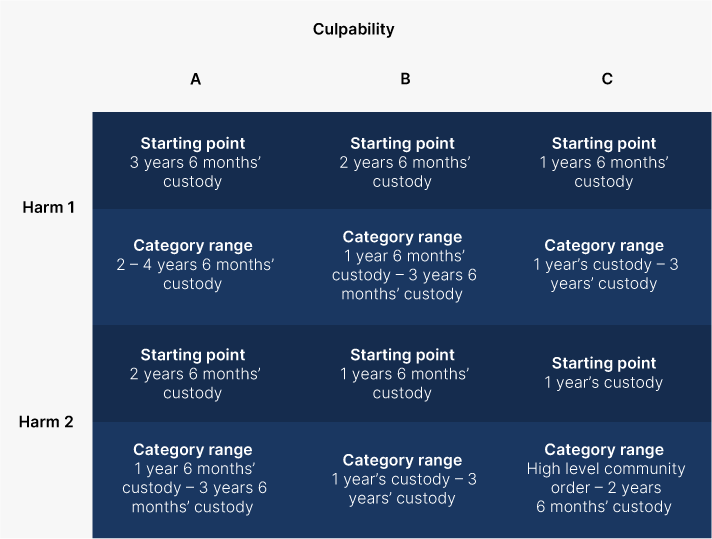
This new guideline provides courts with a structured approach to sentencing this offence.
The offence range spans from a High-Level Community Order at the lowest end, up to 4 years 6 months’ custody at the top of the range for the most serious cases (with the maximum being 5 years). This means that in the least serious scenario (perhaps a very fleeting incident with strong mitigation), a community-based penalty might be possible. On the other hand, the most serious non-fatal strangulation cases (short of those causing injuries chargeable as more serious offences) could approach around four-and-a-half years in prison.
The guideline categorises culpability and harm on a scale. All strangulation offences are considered to involve very high harm inherently (because of the terror and risk posed). However, the guideline distinguishes cases where the victim suffers particularly severe physical or psychological injury (these would be higher harm category). Culpability factors include things like whether the strangulation was sustained or repeated and whether a weapon or ligature was used (higher culpability), versus a brief incident or situations of reduced responsibility (lower culpability).
For example, a one-off incident where the offender immediately desisted and the victim had no lasting injury might fall in a lower category (perhaps resulting in a sentence around 1 year or even a community order). Conversely, a case involving sustained strangulation, or strangulation alongside other violence, especially in a domestic context, could be near the top end (3 to 4+ years imprisonment) even if the physical injury was not permanent. Use of an object like a rope (a ligature) or attacking someone in their own home are aggravating factors that push sentences higher
The guideline also notes that if the offence is racially or religiously aggravated (charged under section 75A in combination with section 29 of the Crime and Disorder Act 1998), the maximum increases to 7 years and a higher sentencing range applies. This would be the case if the strangulation was committed with clear racist or religiously prejudiced motivation.
In summary, under the new guideline judges will typically start with a prison sentence in mind due to the inherent seriousness. The Sentencing Council has effectively affirmed what the Court of Appeal earlier indicated: immediate custody is expected in most non-fatal strangulation cases, unless there are truly exceptional circumstances mitigating the offence.
Even before the official guideline, the appellate courts had made it clear that this offence should usually result in jail time. As a potential client it’s important to understand that if convicted, a prison sentence is likely. The length of sentence will vary based on the circumstances — factors like:
- Was it a prolonged attack?
- Were there any previous domestic abuse incidents?
- Did the victim suffer any lasting trauma?
- Was alcohol or a weapon involved?
All these details can increase the severity. On the other hand, mitigating factors (such as no prior convictions, genuine remorse, or particular personal circumstances) can reduce the sentence.
Aside from imprisonment or fines, a conviction for non-fatal strangulation can have additional consequences. Courts often impose a restraining order especially in domestic cases to protect the victim. The conviction will be recorded on your criminal record (which can affect employment and travel).
Recent Case Law – Non-Fatal Strangulation
Because the offence of non-fatal strangulation only came into force in mid-2022, case law is still developing. However, there have already been a few important Court of Appeal decisions providing guidance on how these cases should be handled by the courts. Understanding these can reassure clients that judges will follow consistent principles, and it also highlights the importance of skilled legal arguments in sentencing.
R v Cook [2023] EWCA Crim 452
This was one of the first appeals to consider a sentence for intentional strangulation. The defendant Cook had pleaded guilty to a single count of non-fatal strangulation (in a domestic context) and was originally sentenced to 15 months in prison.
On appeal, the Court of Appeal noted the lack of sentencing guidelines and took the opportunity to set out a “rough and ready” sentencing framework. The Court held that a custodial sentence will almost always be appropriate for this offence (unless there are truly exceptional mitigating circumstances). They stated that “ordinarily that sentence will be one of immediate custody, with a starting point of 18 months’ custody.”
In other words, for a typical case of strangulation, 18 months’ imprisonment is a baseline after a trial (which could be reduced for a guilty plea). The Court also warned against mechanically applying the harm categories from the ABH (Actual Bodily Harm) guidelines, since by definition strangulation doesn’t require harm for the offence to be complete. Instead, judges should focus on the fact the act itself is serious and then consider specific aggravating factors (the Court in Cook listed factors like a history of violence, if the incident was prolonged, presence of children, etc., as things that can make the case more serious). The gender of the offender or victim is irrelevant to sentencing – the law is gender-neutral and the same principles apply to all.
R v Yorke [2023] EWCA Crim 1043
In Yorke, the Court of Appeal revisited strangulation sentencing later in 2023. The Court in Yorke reaffirmed the guidance from Cook, describing that “a very significant degree of harm is inherent in an offence of intentional strangulation”. They confirmed that the 18-month starting point approach should be followed in general. Yorke’s case also underscored that when assessing harm for sentencing, judges should be cautious: early victim statements might not capture long-term psychological harm accurately
Essentially, Yorke didn’t change the principles but bolstered them, making it clear that strangulation offences must be treated seriously even if the immediate physical harm seems minor.
R v Butler [2023] EWCA Crim 800
This case addressed situations where non-fatal strangulation is charged alongside other offences (for example, a common scenario might be a charge of Actual Bodily Harm (ABH) or common assault in addition to the strangulation). The Court of Appeal in Butler advised that when sentencing, the judge should start by determining the appropriate sentence for the strangulation offence on its own, and then consider any uplift for the accompanying violence, rather than the other way around.
This is because strangulation is likely the more serious aspect if it’s part of an incident that also involved other assaultive behavior. The court must avoid “double counting” but also ensure the total sentence reflects the whole crime. In practical terms, this means if someone is convicted of strangling someone and causing some injury (ABH), the strangulation drives the sentence and the injury adds to it, rather than treating the injury as primary.
Since the law’s introduction, there have been numerous prosecutions for non-fatal strangulation across England and Wales. In the first year alone, thousands of charges were brought – a CPS report indicated that by late 2024, over 12,000 such charges had reached the courts since the offence came into effect. This shows that police and prosecutors are actively using this law in domestic abuse cases.
One high-profile case reported in the media involved a man in Manchester who strangled his partner to the point of unconsciousness; he was ultimately convicted (in that extreme case, of attempted murder) and faced a lengthy prison term. While that particular example was charged as attempted murder due to intent to kill, it highlights how strangulation incidents are being taken extremely seriously. Most cases, however, will be charged under the specific Section 75A offence when appropriate, and we are seeing courts impose sentences ranging from around 1 year to 4 years depending on the circumstances, in line with the guidance mentioned above.
The developing case law confirms that judges treat non-fatal strangulation as a grave offence, especially in a domestic context. Each case will turn on its facts – for instance, if the strangulation was part of a pattern of abuse, sentences will be higher. The courts also recognize that victims may suffer invisible long-term trauma from strangulation. For someone accused of this offence, it means that mitigating the circumstances and presenting your side of the story effectively (for example, if the incident was isolated, out-of-character, or there was any element of self-defence or lack of malice) is crucial to avoid the court viewing the case at the highest severity. That is where experienced legal representation is vital.
How Olliers Solicitors Can Help
Olliers Solicitors is a leading criminal defence firm with extensive experience in serious allegations, including those arising from domestic incidents. We understand that being accused of an offence like non-fatal strangulation can be frightening, stressful, and often complex. Such cases are rarely as straightforward as they might first appear. There are always two sides to the story, and we make sure your side is heard and properly represented. Our team at Olliers can assist you at every stage if you are facing a non-fatal strangulation allegation:
Early Advice and Intervention
It is crucial to get legal advice as soon as possible. If the police have invited you for a voluntary interview or if you’ve been arrested on suspicion of this offence, having a solicitor present to advise you is essential. We specialise in pre-charge representation – this means we often get involved before any charges are brought. At this stage, we can engage proactively with the police and the Crown Prosecution Service (CPS). For instance, our lawyers can make pre-charge representations to the CPS about the evidence (or lack of evidence) and argue why a charge should not be brought, especially if your case is one where there’s insufficient evidence or it’s not in the public interest to prosecute.
In some cases, early pre-charge engagement and robust representations can lead to the matter being dropped without formal charge.
Building Your Defence
If you are charged and the case proceeds, we will thoroughly investigate the allegations. Non-fatal strangulation cases can hinge on witness testimony, medical evidence (like any injuries noted or lack thereof), and context. We will obtain and scrutinise all the evidence disclosed by the prosecution. Where needed, we can gather defence evidence – for example, if there were messages or emails that provide context to the incident, or if there are witnesses who can speak to events leading up to the allegation. In some cases, expert evidence might be relevant (for example, medical experts to interpret any injuries or lack of injuries, which can sometimes support the defence version of events).
Mitigation and Sentencing
If the evidence is strong and you decide (after our advice) to plead guilty or are found guilty, our role is then to mitigate on your behalf to achieve the best possible outcome. We will present the court with all relevant mitigating factors: this can include your personal background, any remorse and steps taken to address behaviour (such as attending anger management or therapy), absence of previous convictions, the circumstances of the offence (perhaps it was brief, or provoked, or completely out-of-character) and anything else that humanises you to the court. Our lawyers are skilled at advocacy and painting a full picture of our clients, not just the offence, which often makes a material difference in the sentence a judge ultimately imposes.
Expertise in Domestic Cases
Olliers has a specialist team for domestic allegations. We appreciate that domestic cases are sensitive – emotions run high, and sometimes complaints can be exaggerated or even false. We approach these cases with discretion and care. Our solicitors will listen to your account of what happened. If there are issues of self-defence, accident, or consent (for instance, if the incident occurred during consensual intimacy), we will explore those defences in detail and advise you on how they can be put forward effectively. We know the legal nuances (like the limited consent defence in strangulation cases) and how to navigate them.
Support and Communication: Throughout the process, we strive to provide a supportive and reassuring service. Being accused of a violent offence can take a toll on your mental well-being, your job, and your family life. We maintain regular communication so you’re not left in the dark. You can rely on our lawyers to explain the proceedings in plain language, keep you updated on developments, and answer any questions you have. We are on your side to guide you through what is undoubtedly a challenging time.
Nationwide Representation
Although our head office is in Manchester (and we also have a London office), we represent clients across England and Wales. Whether your case is in a Magistrates’ Court or Crown Court anywhere in the country, our team can assist. We often deal with cases remotely as well, which means we can advise and prepare your case even if you’re not near our offices, ensuring you get the best defence wherever you are.
Why Choose Olliers?
Above all, we understand that every case is unique. We take the time to understand your situation fully. Our approach is non-judgmental, confidential, and focused on achieving the best possible outcome for you. If you’re innocent of the charge, we will vigorously defend you to clear your name. If there’s truth to the allegation, we will still ensure you are treated fairly and work to minimise the consequences.
Our senior lawyers are all leaders in their field. Olliers is ranked as a top tier law firm by both the authoritative guides to the professions, namely the Legal 500 2026 and Chambers Guide 2026. We are a Times Best Law Firm 2026. We are the Manchester Legal Awards 2025 Crime Team of the Year, an award we have won eight times since 2011. We are known for our creative and dynamic attitude to problem solving, offering a tailored approach to every case.
Contact our specialist team
If you face an allegation of domestic abuse of any kind, it is important not to sit back and leave the police to investigate the matter. At Olliers we adopt a proactive approach during criminal investigations.
If you are facing an accusation of non-fatal strangulation or any domestic violence offence, we encourage you to get in touch as early as possible. The sooner we can get involved, the more we can do to help. You can contact our specialist team by calling 0161 834 1515 (Manchester) or 020 3883 6790 (London), or by emailing info@olliers.com. We offer a confidential initial discussion to discuss your case and outline the next steps.




Complete the form below and we will contact you
Manchester
Head Office
- 0161 8341515
- info@olliers.com
- Fourth Floor, 44 Peter Street, Manchester, M2 5GP