

Written 19th March 2026 by Ruth Peters
The Sentencing Act 2026 represents the most significant overhaul of sentencing law in England and Wales for more than a decade. It arrives at a time of intense pressure on the prison estate, with the government aiming to reduce unnecessary short custodial sentences while strengthening community-basedalternatives.
In short, it is a change in the law governing sentencing, release, bail and the management of offenders after sentence. It implements many of the recommendations of the Independent Sentencing Review released in May 2025.
The Act aims to ensure that the time a person spends in custody more clearly reflects the seriousness of their offending, but also that community-based supervision is used more effectively to reduce reoffending and protect the public.
For anyone facing criminal proceedings, clarity about what has changed (and when those changes come into force) is essential. At Olliers, we specialise in pre‑charge and criminal defence representation, and we understand how these reforms will impact cases from March 2026 onwards.
Below is a clear breakdown of what the new law does, who it affects, and the key dates you need to know.
When Does the Sentencing Act 2026 Take Effect?
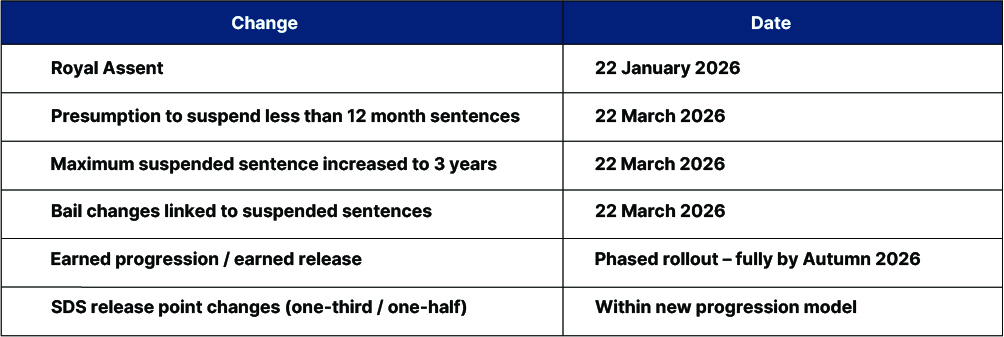
The Sentencing Act 2026 received Royal Assent on 22 January 2026. Most of the major changes take effect today, exactly two months later. These apply to anyone convicted on or after that date, regardless of when the offence was committed.
Further elements, particularly the new “earned progression” release model, will be introduced gradually and are expected to be fully operational by Autumn 2026.
Presumption in Favour of Suspended Sentences (From 22 March 2026)
One of the biggest changes is a new legal presumption that custodial sentences of 12 months or less must be suspended, unless there are exceptional circumstances relating to the offence or offender.
This marks a major cultural shift away from short prison sentences, which the government acknowledges are ineffective in reducing reoffending and contribute significantly to prison overcrowding.
What this means in practice
- Far fewer low‑level offenders will receive immediate custody.
- Courts must justify any decision to impose a short custodial sentence that is not suspended.
- This change applies only to offenders convicted on or after 22 March 2026.
Suspended Sentences Extended to Three Years (From 22 March 2026)
The Act increases the maximum length of a custodial term that can be suspended from two years to three years.
Why this matters
This gives judges far greater flexibility. For appropriate cases, longer prison terms can now be imposed but suspended, offering:
- Structured rehabilitation in the community
- The threat of activation if the offender reoffends or breaches requirements
- A meaningful alternative to custody for cases that fall between low‑level offending and serious criminality
This is a substantial expansion of the suspended sentence regime and is expected to reduce pressure on the prison estate.
Changes to Bail (from today)
The Bail Act 1976 has been amended so that defendants who are likely to receive a suspended sentence benefit from a presumption in favour of bail. This reflects the reality that many offenders who previously would have received short immediate custody will now avoid prison altogether.
‘No real’ prospect test
The first change to the Bail Act 1976, as amended by the Sentencing Act 2026, is a change to the ‘no real prospect’ test. The Sentencing Act introduces a presumption to suspend short sentences of 12 months or less. With a presumption in place, immediate imprisonment is expected to become less likely in these cases, and the court should be able to better anticipate whether a defendant will go on to receive a sentence of immediate custody when deciding whether to grant or refuse bail.
Where an immediate custodial sentence appears unlikely, it follows that there is less justification for remanding a defendant into custody. The ‘no real prospect’ test is therefore amended to a ‘no real prospect of immediate custody’ test, so that fewer exceptions to bail will apply.
The ‘no real prospect of immediate custody’ test will apply where the court considers a) that there is no real prospect that the defendant will be sentenced to an immediate custodial sentence and b) to defendants who have been convicted but are awaiting sentence.
Electronic Monitoring
The second change to the Bail Act 1976 concerns the ability of the court to impose electronic monitoring. Currently, the Bail Act 1976 provides that electronic monitoring can only be imposed on an adult defendant where the court is satisfied that without the requirement the person would not be granted bail. This means that without a change to the Bail Act 1976, those defendants that would now be bailed under the amended “no real prospect” test could only be subject to electronic monitoring where it was necessary to prevent a remand into custody on one of the more limited exceptions to bail that would apply by virtue of the “no real prospect” test.
The changes made by the Sentencing Act 2026 amend the test for eligibility for electronic monitoring in the Bail Act 1976 for defendants, so that it is no longer necessary for electronic monitoring to be an alternative to a remand in custody. If the statutory conditions are met, an electronic monitoring requirement will be available where the court concludes that there is a real prospect of a suspended sentence and no real prospect of an immediate custodial sentence.
Additional relevant factors
The final change being made to the Bail Act 1976 is the addition of further statutory factors that the court should consider when deciding whether to bail or remand. The Bail Act 1976 currently provides that when considering whether certain exceptions to bail apply, the court should have regard to certain factors such as the character of the defendant, the seriousness of their offence, “as well as to any others which appear to be relevant”.
The Bail Act is amended and adds the following factors as potentially relevant factors to this list:
- The defendant is pregnant;
- The defendant is a primary caregiver; and
- The defendant has been a victim of domestic abuse.
While these factors can already be taken into account where relevant, including them in legislation will help ensure that the court takes them into consideration.
Earned Progression and Earned Release – Phased Rollout to Autumn 2026
The Act introduces a major reform of Standard Determinate Sentences (SDS), creating a more structured, three‑stage sentence:
- First third: Custody
- Second third: Intensive community supervision
- Final third: Licence with reduced supervision except for serious cases
Under the new rules:
- Offenders who previously would have been released at 40–50% will now be eligible at one-third.
- Offenders who previously were released at two‑thirds (typically for violent or sexual offences) will now be eligible at one‑half.
The Government has confirmed that the new earned release model will be fully operational by Autumn 2026.
Why These Reforms Are Happening
Between October 2022 and August 2024, the adult male prison population reached 99.7% capacity, triggering what many described as a crisis in the prison system.
The Sentencing Act 2026 is the Government’s legislative response, aiming to:
- Reduce short prison sentences
- Expand and strengthen community‑based punishments
- Manage prison capacity
- Improve rehabilitation and reduce reoffending
These reforms directly respond to longstanding evidence that short custodial sentences are less effective at reducing reoffending than community‑based alternatives.
Key Dates at a Glance
Contact Olliers for Expert Advice on the Sentencing Act 2026
If you or a loved one may be affected by the changes introduced by the Sentencing Act, you do not have to navigate this alone. The law is evolving quickly, and early, proactive advice can make a significant difference to how a case progresses.
Our specialist criminal defence team are here to support you with clear guidance, careful preparation and a sensitive, client‑centred approach. We will take the time to understand your situation and explain your options in straightforward terms.
For confidential expert advice, contact Olliers Solicitors on 0161 834 1515 or email info@olliers.com or complete the web enquiry form below. Our team are ready to help.

Manchester
Head Office
- 0161 8341515
- info@olliers.com
- Fourth Floor, 44 Peter Street, Manchester, M2 5GP
- About the Author
- Latest Posts

Ruth leads the business development team at Olliers across all areas of specialism. Ruth was the Manchester Legal Awards 2021 Solicitor of the Year.
She has been with the firm for more than 20 years and has an enviable level of experience across the entire spectrum of criminal defence.