

Written 2nd January 2026 by Austin Anderson-Brettell
Being charged with drink driving can feel overwhelming. You might be wondering what happens next, what to expect in court and how to prepare. This article will walk you through the process step by step so you can approach your hearing with confidence.
Before the Drink Driving Court Hearing
Once you have been charged with a drink driving offence, you will receive a court date, usually at the Magistrates’ Court closest to where the alleged offence occurred. It is important to read all the paperwork you have received carefully, as it will confirm the date and time of the hearing. Missing your hearing will likely result in a warrant for your arrest, so make sure you know when and where to attend.
Before your hearing, it is highly recommended you seek specialist motoring legal advice. A motoring solicitor can explain the charge, assess your account/the evidence and advise you on how to plead. Even in cases where you decide to plead guilty, legal representation can be valuable in presenting mitigation and ensuring the court has a full understanding of your circumstances.
What should I wear to attend court?
One of the first things you will want to think about is what you wear. The court expects people to look presentable, so aim for wearing smart clothing. A suit or formal attire is ideal, but if that’s not possible, avoid t-shirts, shorts, jeans, or anything with offensive language or images. It might seem obvious, but dressing appropriately shows respect and can help make a positive impression.
Bringing someone with you on the day for support is also a good idea. Court hearings are open to the public, so family or friends can attend. Having someone there can make the experience less intimidating.
If you are unrepresented, another practical tip is to make sure you have copies of any documents you might need, such as letters of support or evidence. If you intend to plead guilty, you may also need to complete a financial means form, known as an MC100 form, before your hearing. This helps the court decide any fines they impose. If you don’t have an income but rely on a partner, the court may take their income into account when fining you. You can find the MC100 form online, and it’s important to bring it with you on the day.
Finally, try to get a good night’s sleep before your hearing. It’s easier said than done but being well rested will help you feel calmer and ensure you are focused on the day. Court can be stressful, but with these simple steps, you’ll be better prepared and more confident to present your case.
Can I drive to court for a drink driving charge?
You should not drive to court on the day of your hearing unless you intend to plead not guilty. If you plead guilty, you will be disqualified on the day (unless there are special reasons for not doing so). Any disqualification would be imposed with immediate effect. Therefore, if you attempted to drive away from court, you could be charged with driving whilst disqualified, which carries the possibility of a prison sentence. I would always recommend making alternative arrangements to get to court, either by public transportation or by being driven by family/friends.
What time should I arrive at court?
Make sure you know the time and location of your hearing. Most hearings are scheduled for either the morning (around 10am) or the afternoon (from 2pm onwards). The court usually breaks for lunch between 1pm and 2pm. Even if your paperwork says 10am, your case might not be heard at that exact time. There are often many cases listed in the same courtroom, and when yours is called on depends on factors like the number of cases and whether there are other high priority or custody matters.
Plan to arrive at least 30 minutes to one hour before your scheduled hearing time. This gives you enough time to find parking and get through security. You can bring laptops, electronics, and cameras into court, but taking photos or recording inside court is strictly prohibited. There are also items you cannot bring in, a full list can be found on Gov.uk here.
What happens at court on a drink driving charge?
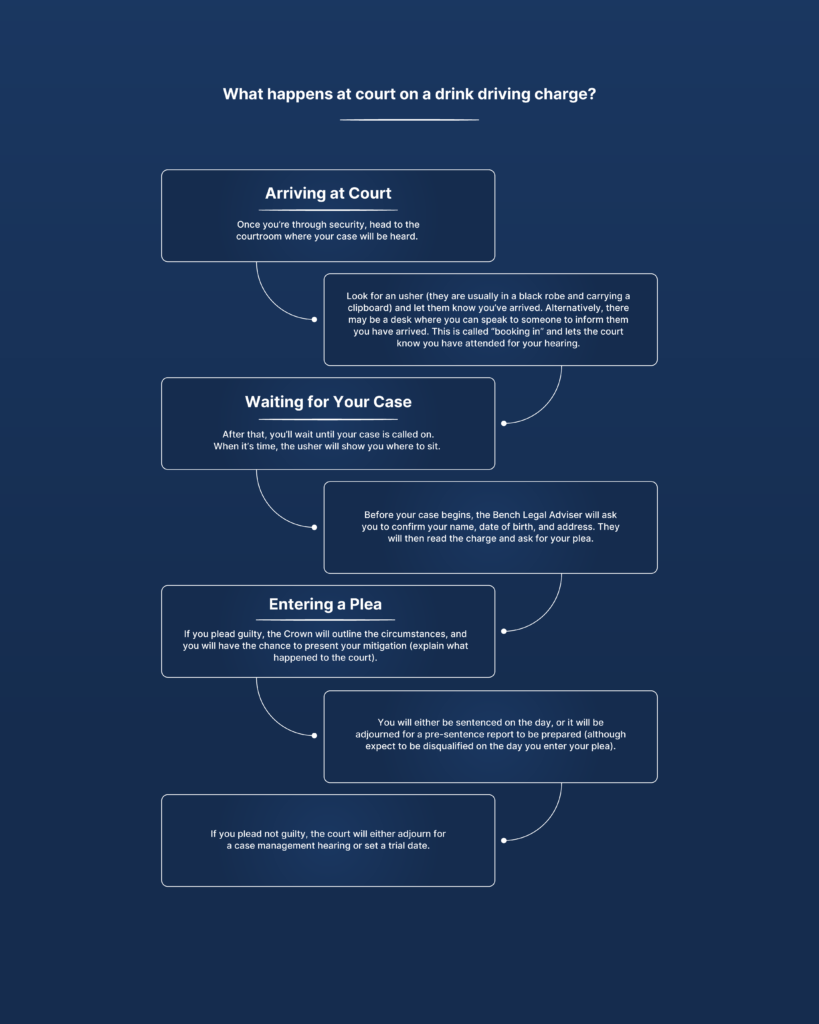
Once you’re through security, head to the courtroom where your case will be heard. Look for an usher (they are usually in a black robe and carrying a clipboard) and let them know you’ve arrived. Alternatively, there may be a desk where you can speak to someone to inform them you have arrived. This is called “booking in” and lets the court know you have attended for your hearing. After that, you’ll wait until your case is called on.
When it’s time, the usher will show you where to sit. Before your case begins, the Bench Legal Adviser will ask you to confirm your name, date of birth, and address. They will then read the charge and ask for your plea. If you plead guilty, the Crown will outline the circumstances, and you will have the chance to present your mitigation (explain what happened to the court). You will either be sentenced on the day, or it will be adjourned for a pre-sentence report to be prepared (although expect to be disqualified on the day you enter your plea). If you plead not guilty, the court will either adjourn for a case management hearing or set a trial date.
Speaking in Court
If you don’t have a solicitor at court for the initial court hearing on a drink driving offence, preparation is key. Whilst I cannot predict or account for every scenario or outline your submissions word-for-word in this article, you should prepare clear and concise points in advance to help structure your representations.
The court will not view preparation negatively, and you are not expected to memorise everything. Speak clearly and confidently, and if you require any reasonable adjustments, such as for hearing difficulties, notify the court beforehand. When presenting mitigation after pleading guilty, carefully explain your circumstances and emphasise the strongest aspects of your case, particularly how any potential driving disqualification and fine, community order, or custodial sentence will affect yourself and others.
Can I bring character references?
If you have obtained character references in advance (which is recommended) you can hand these up to the court. Attention should be drawn to any documentation that supports your position.
It is recommended that you keep your submissions focused. Once you have made a point clearly, avoid repeating it unnecessarily. Hearings of this nature are usually brief, so aim to be succinct. If you lose your place, pause and compose yourself, the court understands you are not legally qualified.
Do I need a solicitor for a drink driving charge?
If you are pleading not guilty, it is highly recommended you have legal representation. We can appreciate this is not always possible, so if you are self-representing, the court will expect you to outline why you are defending the case and what your defence(s) are. Expect some scrutiny from the court or prosecutor, and if faced with an unexpected question, take a moment before responding. Calm, prepared, and structured responses will help you navigate the process effectively.
Speak to One of Our Specialist Motoring Solicitors Today
If you are facing court for a drink driving offence, early legal advice can provide clarity and peace of mind. Our experienced motoring solicitors can guide you through the court process with clear, practical advice tailored to your situation. To discuss your case in confidence and understand your options, contact Olliers Motoring department today.
Contact our specialist motoring team by completing the form below, emailing info@olliers.com or telephoning 0161 8341515 (Manchester) or 02038836790 (London).
Manchester
Head Office
- 0161 8341515
- info@olliers.com
- Fourth Floor, 44 Peter Street, Manchester, M2 5GP
- About the Author
- Latest Posts

Austin joined Olliers in 2025, having trained and qualified as a solicitor at a leading firm in the Manchester area. Austin brings with him a strong foundation in criminal defence and a commitment to client-focused representation.