

Written 8th April 2026 by Aimee Darbyshire-Ellison
Being placed on pre‑charge bail for a rape allegation can feel overwhelming and frightening. For many people, the first question is a simple but urgent one: what does this actually mean for me, and how long can this drag on for? Pre‑charge bail allows the police to continue investigating while imposing restrictions on your life, often for months or even years, without any charge being brought. During this time, it is common to feel as though everything has been put on pause; work, relationships, plans for the future, all while living with uncertainty and very few answers. This guide explains what pre‑charge bail is in rape cases, why it is used, how long it can last and what rights you have during this difficult period.
What is pre-charge bail?
After an individual has been held in custody, the police must decide whether to charge that person with the offence for which they were arrested, release them with no further action, release under investigation or release on pre-charge bail.
Pre-charge bail is a legal process where an individual is released from custody with specific conditions while the investigation is ongoing. Pre-charge bail is used when the police lack sufficient evidence for a charge, but enough evidence to suspect the individual is involved in the offence alleged.
Why is pre-charge bail used in rape investigations?
Pre-charge bail is a method of managing risk. In serious sexual offence cases, pre-charge bail is used to release individuals from custody while the investigation continues. The specific conditions imposed on pre-charge bail are there to protect the safety of victims and witnesses as well as the investigation.
The use of pre-charge bail must be necessary and proportionate. It is a balance between the rights of the suspect under investigation and protecting the complainant.
What does the recent Thematic Rape Inspection Report say about pre-charge bail?
What is the impact of long pre-charge bail periods?
Long periods on pre-charge bail creates uncertainty for individuals under investigation. The delays in investigation can create practical consequences. The bail period can impact a suspect’s work, family life and mental health.
Clients often refer to feeling like their life is on hold while the allegations are hanging over them.
What are common bail conditions in rape cases?
Specific conditions in relation to serious sexual offences commonly include:
- Non-contact with the complainant, directly or indirectly
- A requirement to reside at a specific address
- A requirement not to attend areas/addresses where the complainant may be/reside.
- Travel Restrictions
- Requirements to return to the police station on specific dates.
- Exclusion zones
- Requirements to inform employers of their arrest
Bail conditions can become disproportionate where standard conditions are used as a cover all, rather than being accommodated to the facts of individual cases.
Risk management vs punishment before charge
Where bail conditions are imposed, they can have a significant impact on a suspect’s life. These restrictions in some cases can result in isolation from family and friends. It is often the case that the pre-charge bail has an effect on an individual’s work.
Being placed on pre-charge bail is not a finding of guilt. There is a danger of pre-charge conditions being overly restrictive resulting in punishment before any charge.
How long can you be on police bail for?
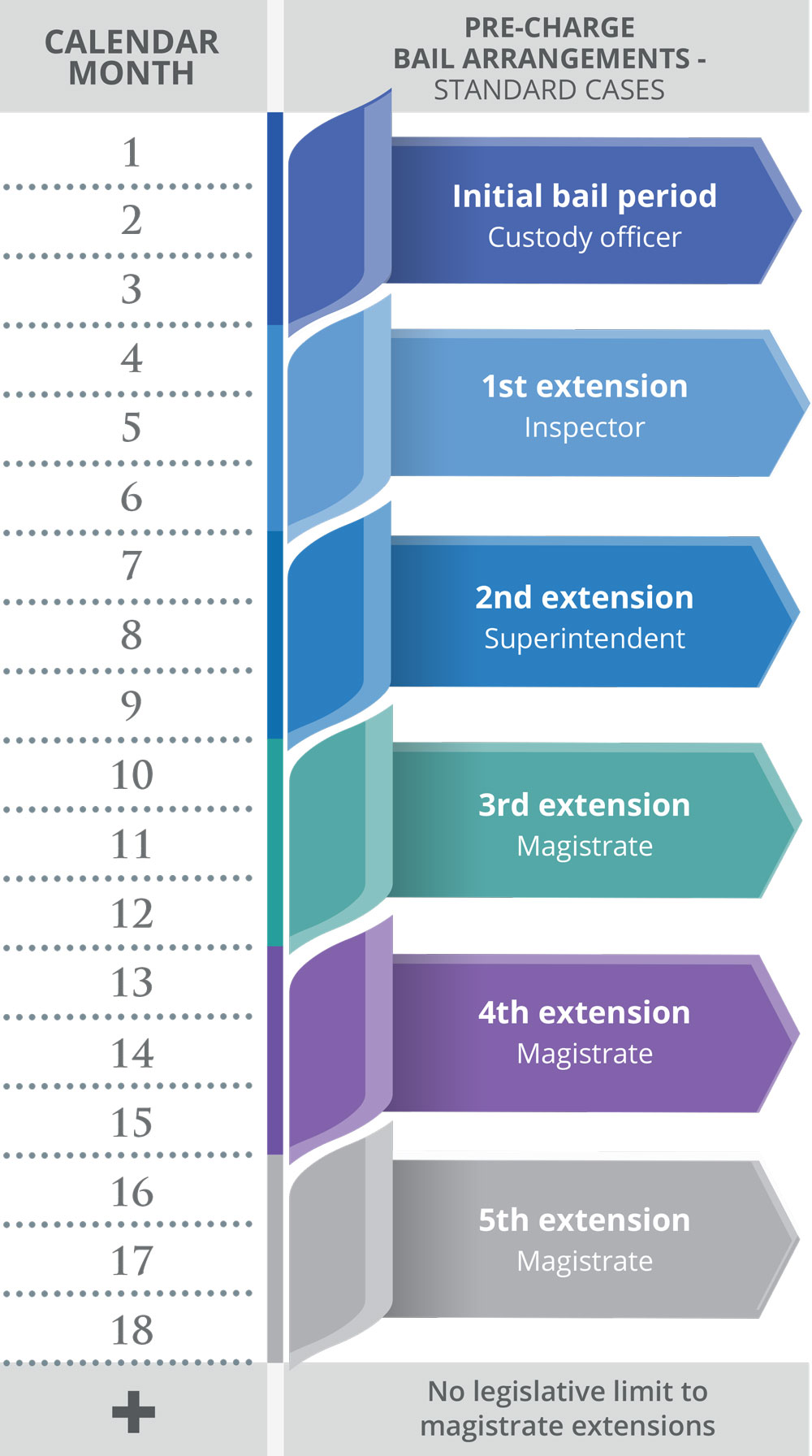
The initial time limit for bail before charge is three months, but the police can seek extensions though internal authorisation, initially at inspector level and then superintendent level up to nine months. Extensions beyond nine months require judicial approval from the magistrates’ court. The Magistrates’ Court has flexibility to grant extensions up to 12, 18 or 24 months in exceptionally complex cases. These extensions require that at each three-month interval there is supervision of the decision to extend the period of pre-charge bail and reasoning for doing so is logged.
What is the difference between pre-charge bail and released under investigation (RUI)?
Instead of pre-charge bail a suspect can be released under investigation. Meaning that though the investigation is ongoing, the suspect is not subject to any specific conditions prohibiting them from doing anything.
The inconsistency between decisions to release on bail or release under investigation have been criticised in the HMPCSI report.
Can you challenge pre-charge bail conditions in rape cases?
It is possible to ask that bail conditions be varied in certain circumstances. Where particularly stringent conditions have been put in place, and there is evidence it is interfering with a suspect’s life significantly, an argument can be made that the conditions are not necessary or proportionate.
In some cases, it is necessary to make an application to vary pre-charge bail in the magistrates’ court. This is done through a solicitor who can make the best case possible for the variation.
It is common that in cases where bail has been extended for a long period of time, an individual under investigation will want to continue with life as normal as much as possible. Some bail conditions can prevent this, for example residence conditions preventing a suspect from going on holiday. A solicitor can negotiate these conditions with the police to enable travel, and where necessary make applications to the Magistrate’s Court.
The importance of early legal advice
Having expert legal representation at an early stage ensures that a suspect’s rights are protected throughout process. Being on bail for prolonged periods of time can create a lot of stress and uncertainty.
In cases where the conditions of bail are affecting a suspect’s employment or day to day life it can be particularly important to have a solicitor at the pre-charge stage.
What does this mean for suspects in rape investigations?
As part of pre-charge work a solicitor will monitor bail extension and ensure police are complying with their legal requirements, challenges can be made where there are unjust or excessive extensions to bail. In addition to this, unreasonable delays can be challenged where it appears police are not making progress in their investigation. A solicitor can request updates from the police and press for a solution where appropriate.
How specialist criminal defence solicitors can help you
Criminal defence solicitors can help by managing bail strategically in serious allegations and can hold the police to proportionality and fairness.
Facing a criminal investigation can be extremely stressful and frightening time for a suspect and their family. Instructing specialist legal representation at an early stage can be extremely beneficial to a suspect, not only are their legal rights protected from the outset, but the uncertainty in relation to the process is removed, a suspect can rest assured that the legal side of matters are being taken care of, and they have a continued point of contact for any questions they or their family may have in relation to the process.
Frequently asked questions
In England and Wales, pre‑charge bail is usually granted for an initial period of up to three months. In serious and complex cases such as rape investigations, bail can be extended with the correct authorisations, including by a senior police officer, a superintendent, or ultimately thecourts. There is no fixed overall time limit, but extensions must be justified and reviewed.
Bail conditions in rape cases are often restrictive and may include non‑contact with the complainant or witnesses, residence requirements, exclusion zones, surrendering passports, restrictions on travel, or limits on internet or phone use. Conditions should be necessary, proportionate, and relevant to the investigation.
In most rape investigations, non‑contact conditions are imposed. Breaching bail by contacting the complainant directly or indirectly can result in arrest and damage your position. Even where no explicit condition exists, contact is strongly discouraged and legal advice should be taken immediately.
Pre‑charge bail usually involves formal bail conditions and a set date to return to the pole station. Release under investigation (RUI) means you are released without conditions, but the investigation remains ongoing with no fixed timetable. Both can leave individuals in limbo, but bail offers set time limits (albeit capable of extension), while RUI can last significantly longer without updates.
Yes. A solicitor can engage in pre-charge engagement and make pre‑charge representations to the police and the Crown Prosecution Service, setting out evidence and legal arguments as to why you should not be charged. This can be a crucial step in attempting to prevent charges being brought.
If the CPS decides there is insufficient evidence or that a prosecution is not in the public interest, the case will be concluded with no further action (NFA). Bail will end, and conditions should be lifted. In some cases, investigations may still be reviewed if new evidence emerges.
Pre‑charge bail is not meant to be indefinite, but in practice it can be extended multiple times in serious cases if procedural requirements are met. Each extension must be properly authorised and justified. A solicitor can challenge extensions that are excessive or unjustified.
Contact Olliers Solicitors specialist sexual defence lawyers
Being on pre‑charge bail for a sexual offence can feel overwhelming. The waiting, the lack of answers, and the fear of what comes next can take a serious toll. You do not have to face this period alone.
If you are on pre‑charge bail, our specialist pre‑charge team can make representations to the police and CPS to protect your position and push for clarity on your case.
If you are facing an allegation involving any kind of sexual offence please contact our new enquiry team on 020 883 6790 (London) or 0161 834 1515 (Manchester) , email info@olliers.com or complete the web enquiry form below to speak confidentially to our team who understand what you are going through.
Manchester
Head Office
- 0161 8341515
- info@olliers.com
- Fourth Floor, 44 Peter Street, Manchester, M2 5GP
- About the Author
- Latest Posts

Aimee is a Trainee Solicitor and Accredited Police Station Representative and is involved in a broad range of case work including pre-charge engagement, Magistrates’ and Crown Court cases. She has worked on a number of complex pre-charge cases including sexual offences, domestic allegations and indecent images.