

Written 9th February 2026 by James Claughton
Being under police investigation is an unsettling experience for anybody. Our clients often feel uncertain, concerned about their reputation, and anxious about what a potential charge could mean for their future and career. It is an unfamiliar process and, understandably, people want clarity, reassurance and realistic guidance.
At Olliers, we work with individuals at all stages of the criminal justice process, but have strong expertise at the pre-charge stage the point where early intervention can make a significant difference to the outcome. One of the most effective ways to avoid prosecution, where appropriate, is using out of court disposals.
These disposals provide alternatives to prosecution in cases that do not require the formality of a court process. This guide explains the range of out of court disposals available, how they operate in practice, and how effective pre-charge representation can increase the likelihood of securing one.
Out of court disposals are not new and have been with us for a long time. In the period between 2015-2025 there was a slight decline in out of court disposals for a variety of reasons. This is likely to change. An increasing number of police forces are placing new emphasis on diverting suspects from criminal justice system. At Olliers, we expect to see an increase in the use of out of court disposals in 2026 and beyond. Sir Brian Leveson’s 2025 ‘Independent Review of Criminal Courts’ calls for a revitalising of out of court disposals (or resolutions) with 10 recommendations for standardisation, better training, digital tools, rehabilitation focus and expanding deferred prosecution.
Understanding Out of Court Disposals
An out of court disposal allows the police or Crown Prosecution Service (CPS) to conclude an investigation without formally charging a suspect. Where appropriate, out of court disposal allow matters to be resolved swiftly, proportionately and without the need for prosecution and the associated costs and stresses.
Out of court disposals are discretionary and the police are not obliged to offer them. Not all offences are eligible for an out of court disposal. The Police will not propose an out of court disposal unless they are satisfied, they meet the relevant evidential and public interest tests. Without proactive representations on your behalf, an appropriate out of court disposal can easily be overlooked in favour of a charge. This is where early legal engagement with the police becomes essential.
The Charging Standard
Charging decisions are made in accordance with the Full Code Test. The first part is the ‘Evidential Test’, which asks whether there is a realistic prospect of conviction. If the evidence is insufficient, the investigation should conclude with ‘No Further Action’. Many Olliers cases resolve at this stage.
However, if the evidential threshold is met, the decisionmaker must then consider the Public Interest Test. This looks at a range of factors including seriousness, culpability, harm, remorse, age, vulnerability, and whether alternative disposals may be more appropriate.
The public interest test is where out of court disposals come into play. They provide a method of recognising wrongdoing and addressing wider concerns without the disproportionate consequences of prosecution. Although those accepting out of court disposals ought to be aware of the risks to DBS checks posed by an out of court disposal discussed below.
Pre-charge representation
The period between police interview and a charging decision can be crucial. During this stage, solicitors can identify evidential weaknesses or mitigating information not yet considered, clarify inaccuracies or misunderstandings arising from the police interview, provide additional documentation, context or material that assists the investigation, highlight welfare, medical or personal circumstances that influence public interest considerations. Solicitors can then propose proportionate alternatives that are appropriate for the case and ensure that your position is articulated clearly and professionally.
In many investigations, the officer’s file is passed to CPS without any representation from the suspect. When we become involved early, we ensure that in appropriate cases your perspective and supporting evidence form part of the decisionmaking process often influencing the outcome significantly.
Types of Out of Court Disposals
Community Resolution
A Community Resolution is an informal method of dealing with low-level incidents, typically involving an acceptance of responsibility and an agreement to take steps such as apologising, compensating the complainant, or undertaking a short restorative action.
A Community Resolution is an informal way of resolving one-off, minor incidents that require a proportionate response. It does not result in a criminal record, nor does it appear as a caution or conviction. Instead, it is recorded on local police systems, as a measure for addressing low-level wrongdoing without the formal consequences of prosecution.
In many cases, Community Resolutions offer a sensible and efficient resolution. They are often underconsidered by officers unless specifically raised, and we routinely negotiate their use where appropriate.
Simple Caution
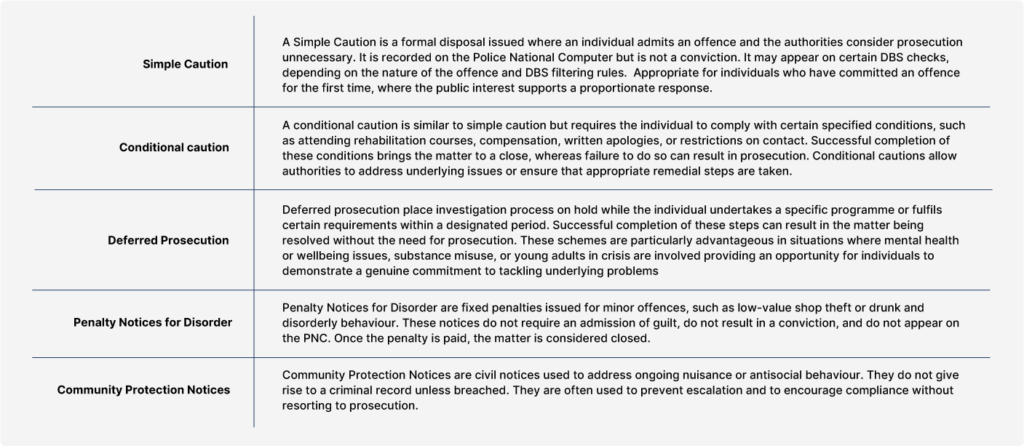
A Simple Caution is a formal disposal issued where an individual admits an offence and the authorities consider prosecution unnecessary. It is recorded on the Police National Computer but is not a conviction.
It may appear on certain DBS checks, depending on the nature of the offence and DBS filtering rules. Simple cautions are frequently appropriate for individuals who have committed an offence for the first time, where the public interest supports a proportionate response.
Conditional caution
A conditional caution is similar to simple caution but requires the individual to comply with certain specified conditions, such as attending rehabilitation courses, compensation, written apologies, or restrictions on contact. Successful completion of these conditions brings the matter to a close, whereas failure to do so can result in prosecution. Conditional cautions allow authorities to address underlying issues or ensure that appropriate remedial steps are taken. We can negotiate conditions that are proportionate, achievable, and appropriate to the circumstances of the case.
The new two-tier system diversionary & community cautions
Reforms introduced by the Police, Crime, Sentencing and Courts Act 2022 are set to replace simple and conditional cautions with a new two-tier system. This system consists of the diversionary cautions which are, designed for more serious cases and involving mandatory rehabilitative conditions, and community cautions, which applies to less serious offences and typically involves lighter or educational requirements. This is intended to achieve a consistent national approach and encouraging rehabilitation. Once fully implemented, they are expected to become the foundation for most adult cautions in the future.
Deferred Prosecution
Deferred prosecution place investigation process on hold while the individual undertakes a specific programme or fulfils certain requirements within a designated period, typically lasting between 3-6 months. Successful completion of these steps can result in the matter being resolved without the need for prosecution, and in some cases, without a caution being issued. These schemes are particularly advantageous in situations where mental health or wellbeing issues, substance misuse, or young adults in crisis are involved it. It provides an opportunity for individuals to demonstrate a genuine commitment to tackling underlying problems and a robust foundation for diversion from formal criminal proceedings.
Penalty Notices for Disorder
Penalty Notices for Disorder are fixed penalties issued for minor offences, such as low-value shop theft or drunk and disorderly behaviour. These notices do not require an admission of guilt, do not result in a conviction, and do not appear on the PNC. Once the penalty is paid, the matter is considered closed. In suitable cases, a Penalty Notice for Disorder can provide one of the quickest and most discreet ways to resolve an incident.
Community Protection Notices
Community Protection Notices are civil notices used to address ongoing nuisance or antisocial behaviour. They do not give rise to a criminal record unless breached. They are often used to prevent escalation and to encourage compliance without resorting to prosecution.
Other Court disposals which do not necessarily involve a charge
Domestic Violence Protection Notices AND Orders
These protective measures can be used following domestic incidents where immediate safeguarding is required. They do not require a criminal charge and do not create a criminal record. In some circumstances, they provide the necessary time and space for matters to be reviewed properly, reducing the risk of premature charging decisions.
When is an out of court disposal realistically possible?
Out of court disposal tend to be most suitable for individuals with no relevant previous history, particularly where the incident sits at the lower end of seriousness. Decisionmakers look for signs of genuine remorse or insight, as well as reassurance that there is no ongoing risk to the public. It is far more likely where rehabilitation is realistic and where a prosecution would be disproportionate to the circumstances of the case.
Out of court disposals are less likely to be offered where there is a pattern of similar behaviour, as repeat conduct indicates higher risk. They are also unlikely to be offered in cases involving serious allegations or where there is a clear, ongoing risk that cannot be adequately managed outside the court process. Finally, out of court disposals are only usually only when there is acceptance of responsibility so will not generally be offered in denied offences.
How to be obtain an out of court disposal
We assess each case on a case-by-case basis, and whether it is appropriate for an out of court disposal. This is done by taking instructions to understand all relevant context, background and mitigating factors. We will then review this in accordance with the charging standard. In appropriate cases we will then liaise with the police and put forward all relevant material and mitigation in support of an out of court disposal.
This mitigation may include treatment, therapy records, employment documentation and character references. We would propose why a noncourt outcome is in the public interest. These proposals may be reinforced by written representations to the police or CPS, around public interest tests.
We will maintain ongoing communication with the investigating officers and ensure they have a full picture of the case. Early engagement is often key to secure the best outcome.
Risks of out of court disposals
While out of court disposals are often the most proportionate and least damaging way to conclude an investigation, it is important to recognise that they can still carry certain implications. Depending on the type of disposal and the nature of the allegation, some may appear on enhanced or standard DBS checks, and cautions are generally recorded on the Police National Computer.
However, when the realistic alternative is a formal charge and the prospect of court proceedings, an out of court disposal will almost always represent the far preferable outcome. A charge exposes an individual to the stress, delay and uncertainty of the court process, the risk of conviction, and far more significant and longlasting consequences. By contrast, an out of court disposal provides a quick resolution that avoids the significant risks associated with prosecution. In most appropriate cases an out of court disposal is preferable.
Conclusion
Out of court disposals offer a fair and proportionate way to resolve many investigations without the consequences of court proceedings. It can protect your career, your family life and your long-term future. It is important to be aware of the possible risks of an out of court disposal at the same time, but it is often the best outcome when the other option is prosecution.
Why Choose Olliers Solicitors?
We don’t wait for events to unfold – we take control. As experts in pre-charge representation, Olliers’ proactive approach ensures we are on the front foot from the outset. We pre-empt issues and build a robust defence strategy from day one. We take control and ensure our clients are in the best possible position.
This is the most important decision you will ever make so invest in the best. This is a critical investment in your life and for your future. Your future deserves nothing less than the best possible defence and the peace of mind that you have paid to have the best team possible in your corner.
By choosing Olliers, you gain immediate peace of mind that you’re in the safest hands. Our proven ability to navigate high-pressure situations means we provide the safe hands needed to protect your freedom, reputation and family. Our decades-long legacy is built on proof – not promises. We have a verifiable record of success evidenced in cases won, awards and accolades achieved, qualifications gained and client testimonials.
Olliers is fuelled by passion, meaningful values and a genuine desire to deliver the best outcomes for our clients. We believe that supporting our clients through their legal journey is as important as the right outcome. Olliers are approachable, non-judgemental and genuine. We build authentic, caring relationships with clients and are genuinely invested in their wellbeing.
Contact our criminal pre-charge investigations solicitors
If you would like to discuss how we can proactively assist you in relation to your case at a pre-charge stage, contact us by telephone on 0161 834 1515, by email to info@olliers.com or complete the form below and we will contact you.
Manchester
Head Office
- 0161 8341515
- info@olliers.com
- Fourth Floor, 44 Peter Street, Manchester, M2 5GP
- About the Author
- Latest Posts

James joined Olliers in 2020, having studied Law with Business at the University of Liverpool followed by a Masters in Legal Practice.
James has a particular interest in the investigation stage of cases and has a significant caseload of pre charge cases. He frequently makes representations against charge on behalf of clients under investigation.